What Are the Differences?
When choosing a club hammer, most people focus on the weight of the head or the material of the handle. However, there is another construction detail that has a significant impact on safety, durability, and ease of use: the assembly system that connects the wooden handle to the steel head.
The two most common systems are the anti-slip club hammer and the bottom-fitted club hammer. Although they may look similar at first glance, the way the head is secured to the handle is fundamentally different, resulting in distinct performance characteristics.
For manufacturers specializing in the production of wooden tool handles, selecting the appropriate assembly system is a crucial aspect of tool design. It is never a random choice, but the result of careful engineering that considers the dimensions of the hammer head, the stresses it must withstand, and the optimal fit between the head and the handle. Every detail is designed to achieve the best balance of safety, functionality, and long-term durability.
The Anti-Slip Club Hammer
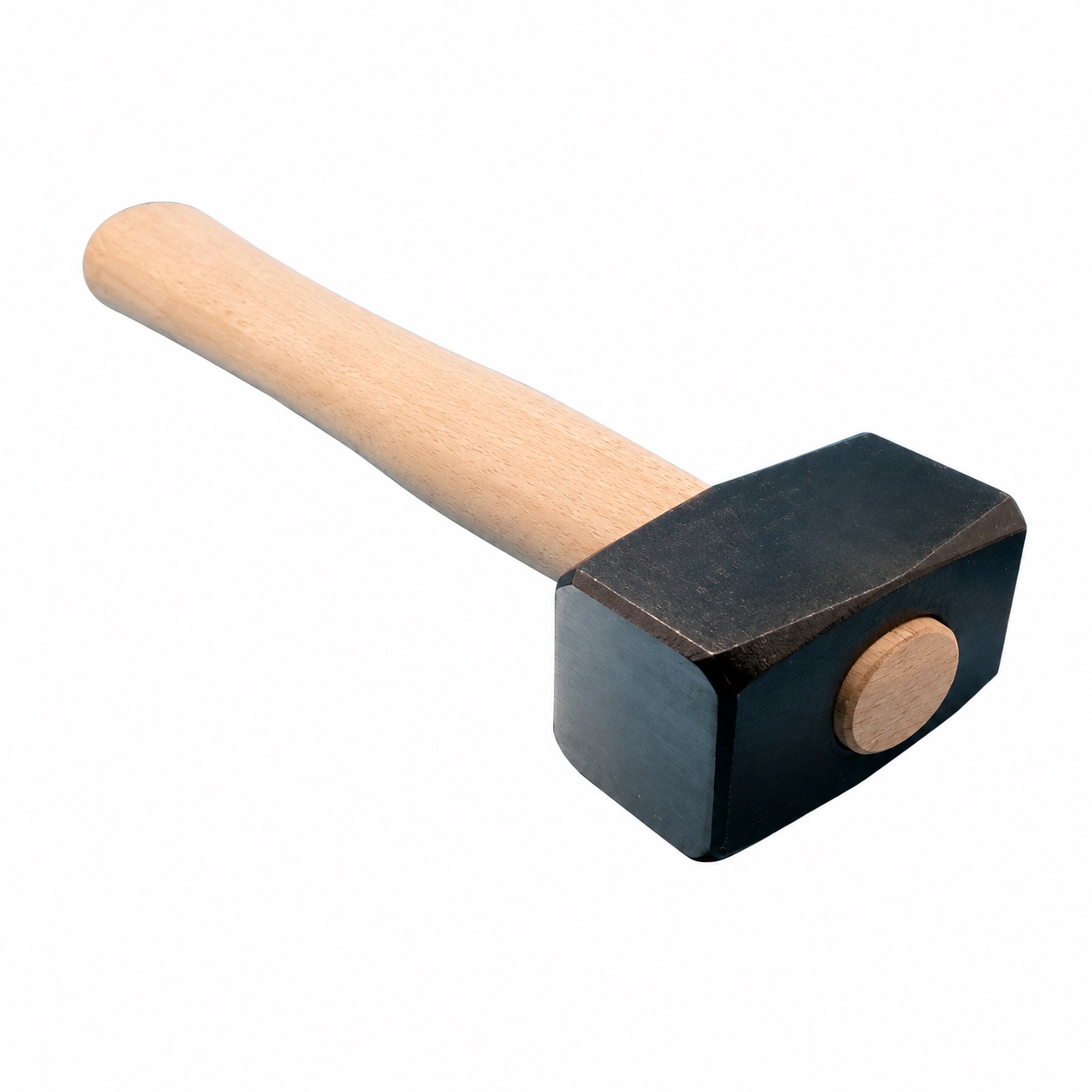
The anti-slip club hammer is designed with an assembly system that maximizes safety during use.
In this design, the handle is inserted from the top. The specially engineered shape of the hammer eye mechanically locks the handle in place. During use, every impact actually increases the tightness of the fit, making it extremely difficult for the head to come loose.
This assembly system therefore offers a higher level of safety than traditional designs, minimizing the risk of accidental head separation even after prolonged and intensive use.
Another important advantage concerns manufacturing efficiency. Production is faster, allowing for a highly efficient assembly process without compromising tool quality.
Maintenance is also particularly simple. If the handle becomes damaged or worn, it can be replaced quickly without using wedges or other fastening components.
Main Advantages
- Superior protection against the hammer head slipping off.
- The locking force increases during use thanks to the geometry of the hammer head.
- Faster manufacturing process.
- Quick and easy handle replacement.
- Excellent durability even under intensive working conditions.
The Bottom-Fitted Club Hammer
In the bottom-fitted club hammer, the handle is also inserted from the bottom of the hammer head. The difference lies in the fastening method.
After the handle is inserted, its upper end is expanded using a wedge, usually made of wood or steel, which forces the handle to expand inside the hammer eye. In many cases, a metal sleeve is also fitted to help maintain pressure between the handle and the hammer head, improving the overall grip.
This is a traditional construction system that has been used in hand tool manufacturing for many years. However, compared with the anti-slip system, its safety depends more heavily on the correct expansion of the handle and the effectiveness of the wedge. Over time, repeated impacts, moisture, and the natural movement of the wood may reduce the clamping force, making periodic inspections advisable.
Main Advantages
- Traditional and well-established construction system.
- Strong and reliable assembly when properly installed.
- Proven technology widely used in the hand tool industry.
- Ergonomic wooden handle.
Which System Is Better?
Both assembly systems are the result of precise engineering choices and provide excellent performance when properly manufactured.
The anti-slip club hammer represents a more advanced solution, where safety relies on the geometry of the hammer head rather than wedges or metal sleeves. This creates an extremely secure connection while offering faster production and easier handle replacement.
The bottom-fitted club hammer remains a traditional and reliable solution, particularly suitable for specific applications, provided that routine maintenance checks are carried out.
Ultimately, the best choice depends on the intended application and the technical requirements of the tool.
The Importance of High-Quality Wooden Handles
The quality of a club hammer depends not only on its assembly system but also on the quality of its wooden handle.
For this reason, the production of wooden tool handles requires carefully selected raw materials, precision machining, and strict quality control. A high-quality handle must provide mechanical strength, dimensional stability, user comfort, and long service life.
The same expertise is applied to the manufacture of shovel handles, hoe handles, rake handles, and many other wooden handles for agricultural, forestry, construction, and gardening tools. Every product is designed to deliver reliability, ergonomics, and safety, even under the most demanding working conditions.
Conclusion
Behind every high-quality club hammer lies much more than a simple connection between the head and the handle. Each tool is the result of careful engineering that considers geometry, dimensions, and the mechanical stresses it will encounter throughout its working life.
For this reason, choosing between an anti-slip club hammer and a bottom-fitted club hammer is never a matter of chance. Each solution is the outcome of detailed design work aimed at achieving the best possible compatibility between the hammer head and the handle.
Experience in the production of wooden tool handles, together with the manufacture of shovel handles, hoe handles, and rake handles, makes it possible to produce reliable, safe, and durable tools that meet the expectations of both professional users and demanding craftsmen.